
New website on marine bioacoustics and ocean noise
FYI – you may be interested in a new website related to some of the kinds of issues SEA is working on in ocean noise. Check out:
Also, below is a short description of the site and it’s content and objectives sent in a recent announcement.
“Dear Colleagues and Associates,
Ocean Conservation Research has assembled an informational website focused on issues concerning the impacts of noise on marine life.
The site is intended for an educated lay audience with some scientific literacy. We have included a sound/audiograph library with biological and common anthropogenic sounds, descriptions and discussions of some of the pressing concerns, links to other resources, papers, media, and descriptions of some of our projects.
Very little of the work represented in the website would have been possible
without the work of many of the people on this circulation list. We have
attributed this work as much as we could, but due to the vagaries of
internet “data mining” it is likely that we have missed some sources.
Please let us know where we have not included proper attributions.
Please also let us know of any errors you find so we can correct them.
If you would like to receive occasional newsletters specifically about
ocean noise and marine bioacoustics you may sign up through the website
or through this link.
We intend the site to be dynamic and evolving and hope that you find it informative.”
New advances in digital textbooks for marine science: CACHALOT
SEA Blog,
Thought you might be interested to know of some recent and very interesting developments in the use of digital multimedia in higher education in marine science. Dr. Dave Johnston from Duke University is spearheading the development and expansion of a remarkable digital texbook called “Cachalot.” This is a free, open-source interactive software appliation that uses the iPad. It is regularly updated to integrate new information and provides photo, video, and audio multimedia information to supplement text.
For more information on CACHALOT and to download the app, go to: http://itunes.apple.com/us/app/cachalot/id458866319
To read more about this remarkable new capability, see the recent feature artcle on it in WIRED: http://www.wired.com/wiredscience/2012/01/flow-digital-textbooks/
CNN Opinion Piece
FYI – Christopher Clark and I had an opinion piece on CNN today. You can find the permalink at: http://www.cnn.com/2012/01/19/opinion/clark-southall-marine/ and the full text is included below.
Thanks also to our friends at Ocean Conservation Research <see: http://ocr.org/2012/ocean_life/marine-scientists-express-themselves-through-cnn/> and at the New Bedford Whaling Museum <see: http://whalingmuseumblog.org/2012/01/20/the-problem-of-noise-in-the-ocean/> for their informative blogs about this article.
Any comments or perspectives on the suggestions we have put forth in this piece are welcome. Brandon Southall
Turn down the volume in the ocean
Brandon Southall, Special to CNN
For many millions of years, the oceans
have been filled with the sounds of a geologically and biologically active
planet: waves, rain, earthquakes and the songs of life from snapping shrimp to
great whales. Before the age of engine-driven ships, the resounding voices of
the great whales could be heard across an ocean.
Today, in much of the Northern
Hemisphere, commercial shipping clouds the marine acoustic environment with fog
banks of noise, and the near continuous pounding of seismic airguns in search
of fossil fuels beneath the seafloor thunder throughout the waters. In the
ocean’s very quietest moments, blue whales singing off the Grand Banks of
Canada can sometimes be heard more than 1,500 miles away off the coast of
Puerto Rico. But on most days, that distance is a mere 50 to 100 miles.
So why should we care?
Over the past decade, scientists who
study noise in the ocean have tried to understand how loud, man-made sounds
disturb or injure whales and other marine mammals, even driving some to strand
on beaches and die.
It is time for us to focus on the more
pernicious influence of chronic, large-scale noise on marine life.
Whales, dolphins and seals use sounds
to communicate, navigate, find food and detect predators. The rising level of
cumulative noise from energy exploration, offshore development and commercial shipping
is a constant disruption on their social networks. For life in today’s ocean,
the basic activities that we depend on for our lives on land are being eroded
by the increasing amount of human noise beneath the waves.
These stark realities are worrying. But
emerging technologies for quantifying and visualizing the effects of noise
pollution can help drive a paradigm shift in how we perceive, monitor, manage
and mitigate human sounds in the ocean. Ocean noise is a global problem, but
the U.S. should step up and lead the way.
First, we must extend fledgling efforts
to fully comprehend the acoustic footprint of our offshore and coastal
activities. As a nation, we are failing the oceans by lacking a sufficiently
effective program for listening to them.
The U.S. should develop and maintain
dedicated undersea acoustic monitoring networks as integral parts of ocean
observing systems. This would be lead by the National Oceanic and Atmospheric
Administration (NOAA) and enabled through private and academic partnerships.
Such a plan has been developed; now it should be implemented.
Second, we should encourage and
accelerate the development of noise-reduction technologies. Thanks to proactive
collaborations among industries, scientists, environmentalists and government
officials, efforts are underway within the U.N.’s International Maritime
Organization to develop quieting technologies for the most pervasive global
noise source: large commercial ships. These and related technologies for
reducing noise in oil exploration and marine construction should be
standardized.
Finally, federal regulation on ocean
noise must be changed. For decades, regulators have focused entirely on the
short-term effects of one action at a time. A more holistic and biologically
relevant risk assessment system, centered on the concepts of ocean acoustic
habitats and ecosystems, is sorely needed. Emerging trends in marine spatial
planning are encouraging signs, as is NOAA’s support of two groups that are
developing geospatial tools for mapping underwater noise and marine mammal
distributions in U.S. waters.
The loss of acoustic habitats for
marine species that rely on sound to live and prosper is increasing. Solutions
are available. The question is whether we humans value and will invest in a
healthy ocean ecosystem that supports life, and in doing so, sustain our own
health and future.
Science Magazine Article on Tag Analysis and SOCAL BRS efforts
Some of the research efforts conducted in SOCAL-BRS were presented and discussed by one of our team members Dr. Jeremy Goldbogen at the recent Society for Integrative and Comparative Biology meeting in South Carolina. A popular press article on some of the work Jeremy has been doing with SOCAL-BRS and other related projects ran recently in Science Magazine <http://news.sciencemag.org/sciencenow/2012/01/a-whales-virtual-reality.html?ref=wp>. The first few paragraphs of the article are given here. Nice work Jeremy!
CHARLESTON, SOUTH CAROLINA—A surfacing whale is a sight to see, but it would be even more dramatic to watch one ply the ocean depths. Researchers have taken a step closer to doing just that with sophisticated radio-tagging technology and a new computer program that uses the data to recreate a whale’s path underwater. The results, presented here yesterday at the annual meeting of the Society for Integrative and Comparative Biology, are helping scientists understand how the school bus-sized beasts are able to take in enough food to sustain their great girth, and how underwater noises, such as sonar, might affect their well-being.
Comparative physiologist Jeremy Goldbogen of the Cascadia Research Collective in Olympia, Washington, studies feeding in blue fin and other so-called rorqual whales. For almost a decade, he and his colleagues have been attaching suction cup radio tags onto the backs of the cetaceans. The tags record depth, sound, and other parameters as the whales swim. After a set amount of time, they fall off, float to the surface, and send out a radio signal so they can be retrieved and their data analyzed.
The work showed that in one giant gulp, a blue whale—the biggest creature on Earth—takes in 125% of its body weight in water and krill. During their dives, the cetaceans ram into patches of krill, opening their mouths wide and wrapping their jaws around prey-laden water, a move that stops them short. Next, they close their mouths and push water through their baleen, a system of plates that filter out the food, then speed up for another feeding bout.
But details about this feeding strategy had been lacking. This past summer, Goldbogen monitored several blue and fin whales with new tag technology that detects the changes in the whales’ orientation in space, much like smart phones “know” whether they’re held in a horizontal or vertical position and adapt screens accordingly. For the 6 to 24 hours they are attached to the whale, the tags also record depth and sound; from the loudness of the water rushing past a diving whale, researchers can calculate its speed. “We use these sensors to reconstruct what the whales are doing,” Goldbogen said.
Recent SMM presentation on Vessel Quieting Technology
All,
At the recent Society for Marine Mammalogy Meeting in Tampa, FL, a number of us co-authored a presentation given by Amy Scholik-Schlomer of NOAA’s Office of Protected Resources. The presentation was entitled:
Reducing Underwater Noise from Large Commercial Ships
Amy R. Scholik-Schlomer (NOAA), Trisha Bergmann (NOAA), Leila Hatch (NOAA), Michael Jasny (NRDC), Kathy Metcalf (Chamber of Shipping of America), Brandon Southall (Southall Environmental Associates/NOAA), Lindy Weilgart (Dalhousie University/ Okeanos Foundation), Andrew Wright (Aarhus University).
.pdf copies of the slides are available on request and additionally, a number of related sites and issues mentioned therein are given here.
* NOAA symposia: http://www.nmfs.noaa.gov/pr/acoustics/shipnoise.htm
* IFAW report on vessel quieting: http://www.ifaw.in/Publications/Program_Publications/Whales/asset_upload_file262_53989.pdf
* Arctic Marine Shipping Assessment (AMSA): http://www.pame.is/amsa/amsa-2009-report
* EU Marine Strategy Framework Directive: http://ec.europa.eu/environment/water/marine/ges.htm
* American National Standard Quantities and
Procedures for Description and Measurement of Underwater Sound from Ships (ANSI S12.64): http://asastore.aip.org/shop.do?cID=10&pID=580
* IMO MEPC reports: These reports have to be
requested directly from your country representative (e.g., In U.S.: US Coast
Guard). Nevertheless, some of these reports have been posted on the web by
other groups. You can try searching “MEPC 57, 58, 59, 60, 61, or 62” and “Noise
from Commercial Shipping and its Adverse Impacts on Marine Life.”
New Book on Effects of Noise on Aquatic Life
A new book was recently released with chapters derived from presentations given at the 2nd International Conference on the Effects of Noise on Marine Life held in Cork, Ireland in 2010. The book is entitled:
The Effects of Noise on Aquatic Life [within the Series: Advances in Experimental Medicine and Biology, Vol. 730]
Popper, Arthur N.; Hawkins, Anthony (Eds.)
2012, 695 p. 167 illus., 57 in color. Hardcover, ISBN: 978-1-4419-7310-8
The book is available at: http://www.springer.com/biomed/neuroscience/book/978-1-4419-7310-8
SEA, Inc. President and Senior Scientist Dr. Brandon Southall gave the keynote lecture at this international symposium. The resulting publication from this lecture appears as the first chapter in this book and is entitled: “Noise and Marine Life: Progress From Nyborg to Cork in Science and Technology to Inform Decision Making.” Hard copy versions of this book chapter are available on request from Brandon.Southall@sea-inc.net
Bahamas BRS Video in Smithsonian Ocean’s Today Kiosk
Please note the availability of a short video summary of our behavioral response study (BRS) from the Bahamas in 2007-2008 — see:
http://oceantoday.noaa.gov/soundsunderthesurface/welcome.html
This video was produced through the Ocean Today kiosk and website by NOAA and is available online as well as in touch screen format at the Smithsonian Natural History Museum in Washington DC and Coastal Ecosystem Learning Centers around the U.S. If you have questions or comments about the project or would like a recent scientific publication of the results, please contact Brandon.Southall@sea-inc.net.
Have a wonderful holidays and a great start to 2012! Brandon
NEW PUBLICATION: A New Context-Based Approach to Assess Marine Mammal Behavioral Responses to Anthropogenic Sounds
All,
Please note the following recent publication in Conservation Biology, co-authored by SEA, Inc. President and Senior Scientist Brandon Southall.
Conservation Biology, Volume **, No. *, 1–8
2011, Society for Conservation Biology
published online: DOI: 10.1111/j.1523-1739.2011.01803.x
The link to the full article is http://onlinelibrary.wiley.com/doi/10.1111/j.1523-1739.2011.01803.x/full
The link to the abstract is http://onlinelibrary.wiley.com/doi/10.1111/j.1523-1739.2011.01803.x/abstract
and the abstract text is given below:
Abstract: Acute effects of anthropogenic sounds on marine mammals, such as from military sonars, energy development, and offshore construction, have received considerable international attention from scientists, regulators, and industry. Moreover, there has been increasing recognition and concern about the potential
chronic effects of human activities (e.g., shipping). It has been demonstrated that increases in human activity and background noise can alter habitats of marine animals and potentially mask communications for species that rely on sound to mate, feed, avoid predators, and navigate. Without exception, regulatory agencies
required to assess and manage the effects of noise on marine mammals have addressed only the acute effects of noise on hearing and behavior. Furthermore, they have relied on a single exposure metric to assess acute effects: the absolute sound level received by the animal. There is compelling evidence that factors other than received sound level, including the activity state of animals exposed to different sounds, the nature and novelty of a sound, and spatial relations between sound source and receiving animals (i.e., the exposure context) strongly affect the probability of a behavioral response. A more comprehensive assessment method is needed that accounts for the fact that multiple contextual factors can affect how animals respond to both acute and chronic noise. We propose a three-part approach. The first includes measurement and evaluation of context-based behavioral responses of marine mammals exposed to various sounds. The second includes new assessment metrics that emphasize relative sound levels (i.e., ratio of signal to background noise and level above hearing threshold). The third considers the effects of chronic and acute noise exposure. All three aspects of sound exposure (context, relative sound level, and chronic noise) mediate behavioral response, and
we suggest they be integrated into ecosystem-level management and the spatial planning of human offshore activities.
Keywords: behavioral context, noise, received level, signal-to-noise ratio
SEA Office Warming Party
SEA, Inc. had the pleasure recently of christening our little office, with fresh ocean-themed paint and everything (thanks Kristin!). It was a wonderful time with great food, live music, and friends new and old, family, and colleagues. We are so fortunate to have the people we do around us in the work we do in many different areas – people matter most of all.
Here are a few fun pictures a wonderful night at our cozy new offices in the redwoods of beautiful Aptos, California and a little musical sample…03 undr
END SOCAL-11
We have reached the end of SOCAL-11. While we had some challenges with weather (a few lightning storms near the end), personnel illnesses (nothing too serious but involved some shuffling), and a very different distribution of animals than the near-amazing abundance of animals in 2010, this was all-in-all a very successful second season. We successfully incorporated two new teams into our efforts, including a towed passive acoustics team operating from a separate vessel (with colleagues from the NMFS Southwest Fisheries Science Center) and fisheries acoustics researchers mapping prey around foraging whales (also from NOAA and Duke University).
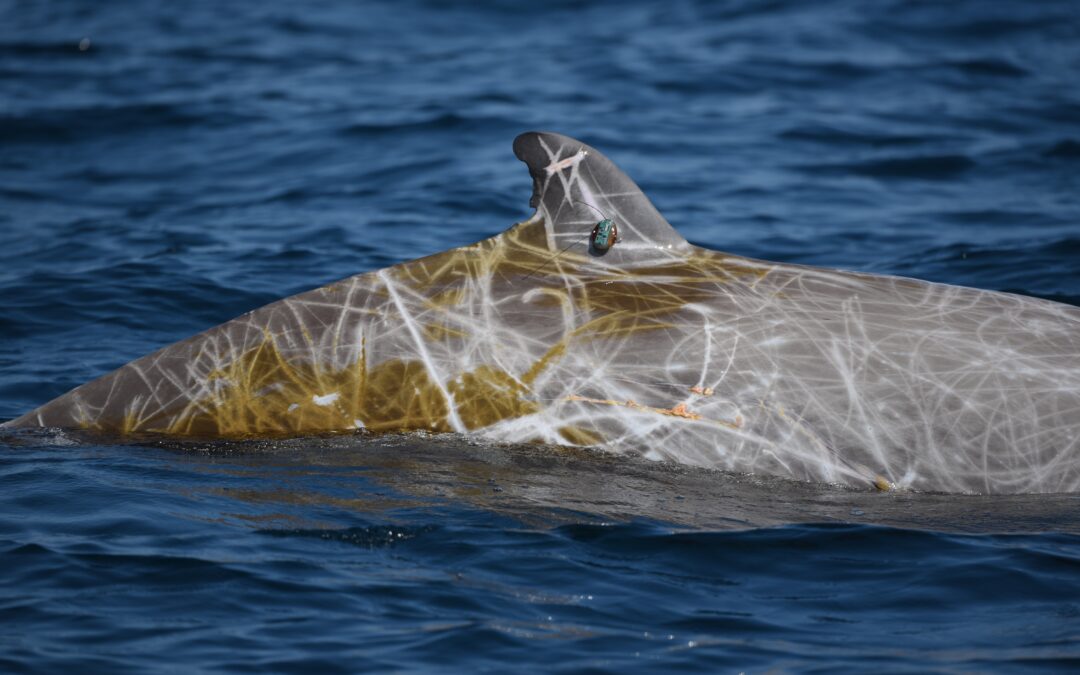
As a simple summary of our accomplishments, we attached 38 tags (including v2 and v3 Dtags (Woods Hole Oceanographic Institution), and Wildlife Computer MK-10 TDRs and TDR-satellite tags) on 25 blue whales, 7 Risso’s dolphins, 2 bottlenose dolphins, and one Cuvier’s beaked whale. Each of these were important accomplishments, but the Cuvier’s was a highlight, as was the relatively large number of Risso’s dolphins for which time-synched movement and acoustic data were previously quite limited. We also conducted CEEs on18 individuals (13 total sequences) including 13 blue whales, 4 Rissos, and one Cuvier’s beaked whale. All of these were completed within all specified protocols, animals were observed following CEEs, and several were cut short because marine mammals ignored the sound source and came within the specified safety zone during transmissions. We are aware of no live stranded marine mammals occurring anywhere near our experimental activities. Finally, we completed three focal follow sequences in testing tagless group follow protocols, including two with common dolphins and one with bottlenose dolphins.
We will be summarizing and analyzing our accomplishments, which will be included in the SOCAL-11 project report that will be issued sometime in early 2012. A blog post and other messages will announce the availability of this report, and it will be posted on www.socal-brs.org. Additionally, SOCAL-BRS will be presented and discussed within a one-day workshop preceeding and at least three formal scientific presentations at the 19th Biennial Conference on the Biology of Marine Mammals in Tampa, FL in November (please see: http://www.marinemammalscience.org/) for more information.
Finally, it has been a tremendous privilege and a pleasure to work with so many talented and dedicated people. We have been trying to do some difficult things, some of which have not been done before, and we had the fortune of an all-star team of scientists and field personnel from all of our partner organizations (Cascadia Research, NOAA, WHOI, NUWC, SPAWAR Systems Pacific, Scripps, Duke University, Applied Physical Sciences, and SEA). We would also like to thank our friends and colleagues at Truth Aquatics in Santa Barbara who operate the R/V Truth and who’s flexibility, patience, and dedication to doing what needs to be done have been central to the success of this project. We also appreciate the help, support, and permission to conduct our work granted by both the NMFS Office of Protected Resources and the Channel Islands National Marine Sanctuary. Finally, we would especially like to thank our resource sponsors (N45 Environmental Readiness Division of the Chief of Naval Operations and the Office of Naval Research) for believing in and enabling this project to proceed.
Below are a number of photos from our efforts on the water (photo credits are included; all were taken under NMFS permit #14534). Please stay tuned for more SOCAL-BRS information in the coming weeks and months, including announcements from and presentations given at th SMM conference.


